I created this poster in 2025 to summarize the ridiculousness of polemical portrayals of Jan van Leiden over the centuries.
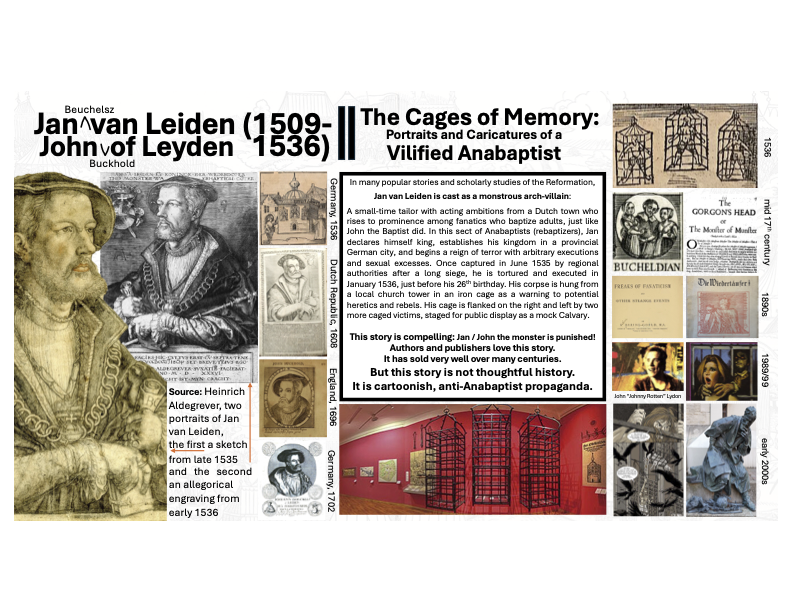
Poster of portrayals of Jan van Leiden, a vilified Anabaptist leader.

I created this poster in 2025 to summarize the ridiculousness of polemical portrayals of Jan van Leiden over the centuries.
Poster of portrayals of Jan van Leiden, a vilified Anabaptist leader.
James M. Stayer was born on March 15, 1935. This is a short post to remember Jim as an influential historian, teacher and friend.
This past September 15 (2025) I spoke at the Acadia University Divinity College about 2025 as an anniversary year in Anabaptist history. The presentation took place soon after Jim’s death on April 23, 2025. In the presentation I make several mentions of Jim’s ideas about and contribution to Anabaptist studies.
A recording of the talk is available at https://acadiadiv.ca/event/zeman-2025/.
For some more about James Stayer, go to https://amsterdamnified.com/JamesMStayer/.

This summer I will visit several sites in Germany connected with the German Peasants’ War of 1524-26.
The latest update is from the middle of July, looking back on my June tour.

On January 1, 1484, Zwingli was born. His life and career were entangled with central events of his age, most notably the rise of anti-Papal reforms. He originally worked with but later reacted against Conrad Grebel and other Christian biblicist radicals — and the same could be said for his relationship with Martin Luther. Like Luther, Zwingli was an early opponent of Anabaptists, and his polemics against them has done a lot to shape historiography of “the fanatical Anabaptists”.
On or around December 27, 1521, a small group of lay preachers began public criticism of sacramental orthodoxy in Wittenberg. Starting in 1522 with Martin Luther’s attacks, they became known popularly as the Zwickau Prophets, since at least one of their leading figures, Nicholas Storch, was from the central German town of Zwickau.

Updated: 3 Jan. 2023. The basic message of this post is: Check out the Vrouwenlexicon!!! There are lots of fascinating details here about the lives of women from adult baptizing backgrounds before 1800. Look below for more details. I cite this post in my 2023 article “The Year 1625, the Dutch Republic, and Book History” (https://www.academia.edu/93269154/The_Year_1625_the_Dutch_Republic_and_Book_History_Perspectives_for_Reframing_Studies_of_Mennonites_and_Early_Modernity_2023_).
Updated: 18 Feb. 2023. In “The Year 1625, the Dutch Republic, and Book History” (Jan. 2023) I provide reasons for preferring “adult baptizers” to “Anabaptists” or even “Mennonites” as a general term. In short, the people who baptized adults in the early modern world were diverse. In addition to Mennonites, they included people from Mennonite milieus who rejected that name, and they included Baptists (of course), as well as some Socinians and Collegiants. With this diversity in mind, I have expanded the list below to include women who do not fit into the general framework of Mennonite church history.
On the technical front, I have also updated the URLs from http the https (it looks like the website has been updated).
Names that I have added in Feb. 2023 I have marked with an *. In an older version of this post I had two lists, and I have now integrated these lists into one.

Last updated: January 2023
Headline:
A mainstream assumption in Mennonite studies since the early 20th century (maybe the 1880s, more accurately) is that early modern Mennonite history (i.e., Mennonite history before 1800 or even 1900) was shaped primarily by German culture and German-language sources. This assumption is problematic because it is built on an empirically questionable foundation. In other words, the sources and evidence for this assumption are weak.
The essay for which I prepared this research — “The Year 1625, the Dutch Republic, and Book Production: Perspectives for Reframing Studies of Mennonites and Early Modernity” — has now been printed in three languages. You can find the details by clicking the links for the German, Dutch, and English versions.

We (my co-editors and I) are pleased to announce the publication of a Special Issue of Church History and Religious Culture (101: 2-3) that was released in late July 2021. The theme is “Spiritualism in Early Modern Europe.”
On the 23rd of June, 2020, I gave a paper via remote link to an audience at the Europa Universität in Frankfurt / Oder. The talk is entitled:
Reflections on The Pursuit of the Millennium, Europe’s Inner Demons, and The War on Heresy: Six-Word Arguments to Highlight Norman Cohn’s Divergent Legacies. (The orange text is important when you peruse the Prezi frames.)
I used the Prezi below in the presentation. You can explore it on your own by going to https://prezi.com/raocgxnxjxkv/. There are many frames that I did not discuss in detail.

If you would like to read my presentation, you can find it by opening the rest of this post.
UPDATE from 27 May 2021: I have changed the title of this post (although the URL remains the same). The original post indicated that the YouTube video and other parts of the post were related to a June 2020 presentation (Vortrag) I was making at the Europa-Universität in Germany.
UPDATE from 24 June 2020: I have put the recording of my presentation on YouTube. The text below is a close but not exact transcript of the presentation.

In the Winter Term of 2020, I led a seminar at Brock University on the theme of “fanaticism”. The post below was material related to the course meeting on 27 Jan. 2020. The subject for the seminar was a comparison of two books…